It’s been a wild roller coaster ride this year. But look – here we are – looking forward to Christmas and the start of a new year.
Covid has acted like a giant lens shining light on all our trials and tribulations. But it has also given us great moments of unexpected human kindness and generosity. In this Christmas season let’s make sure the lens shows more of Christmas joy, love and generosity.
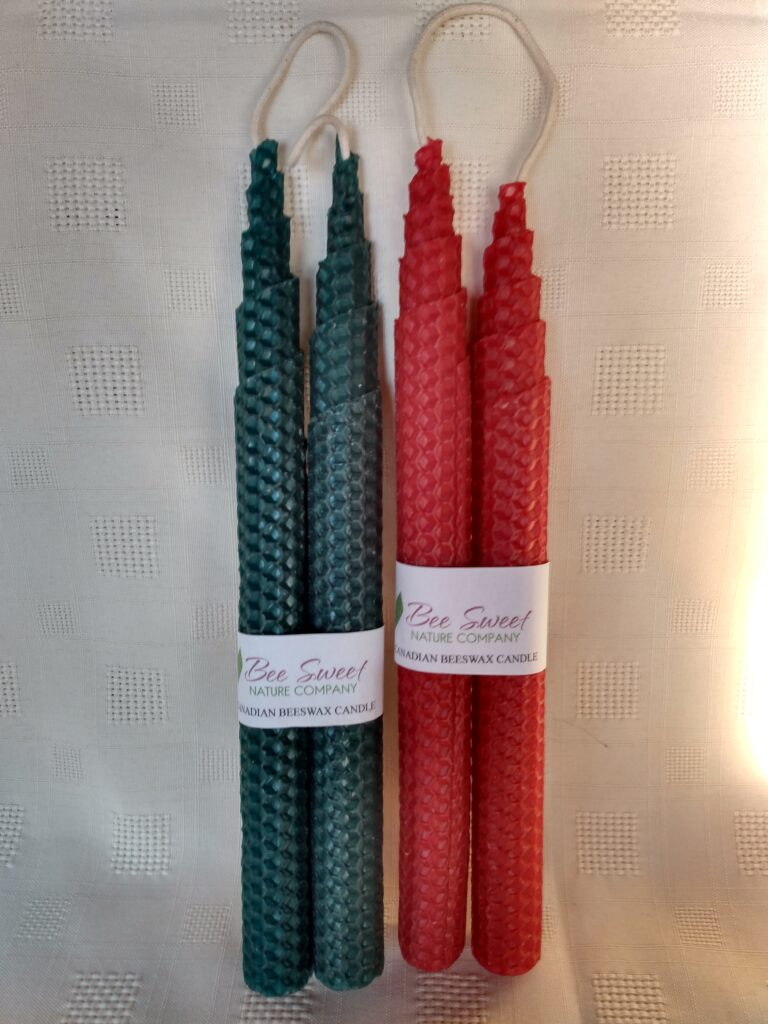
We have added 100% Canadian beeswax candles to our marketplace. To celebrate the launching of these new products, we have decided to offer some fun Black Friday specials.
Illuminations – Taper
Mix and match any 2 pairs of taper candles, any color.
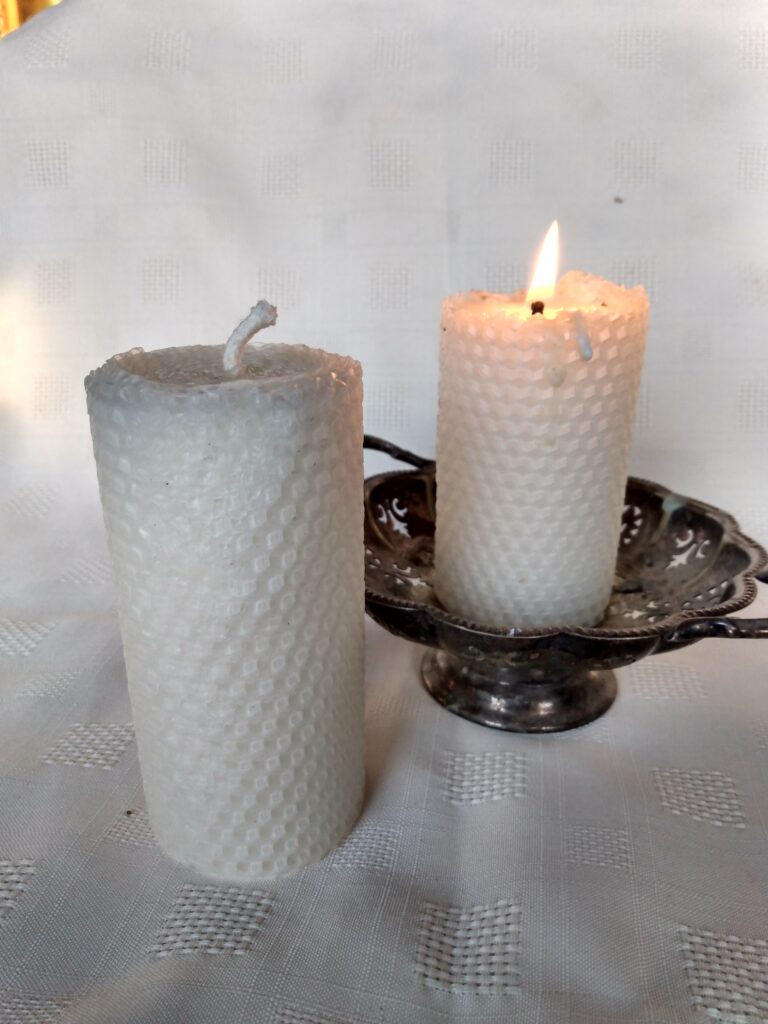
Illuminations – Pillar
Mix and match any 2 pairs of pillar candles, any color.
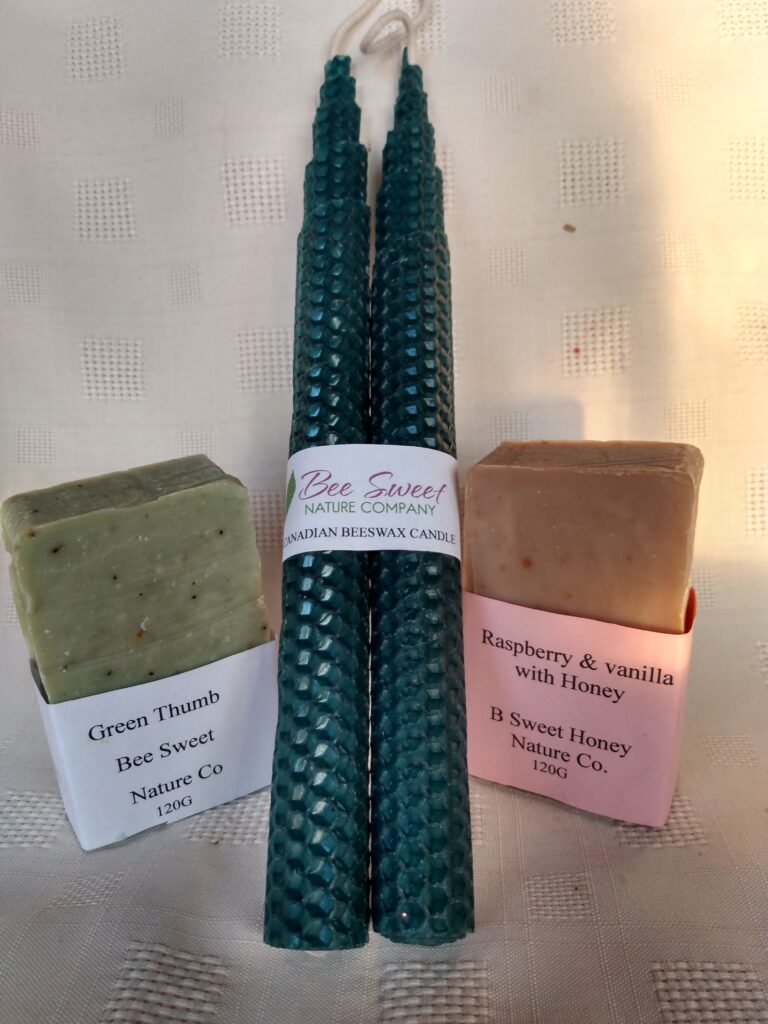
Pamper
Any 2 handmade soaps and 1 pair of tapered candles, any color.
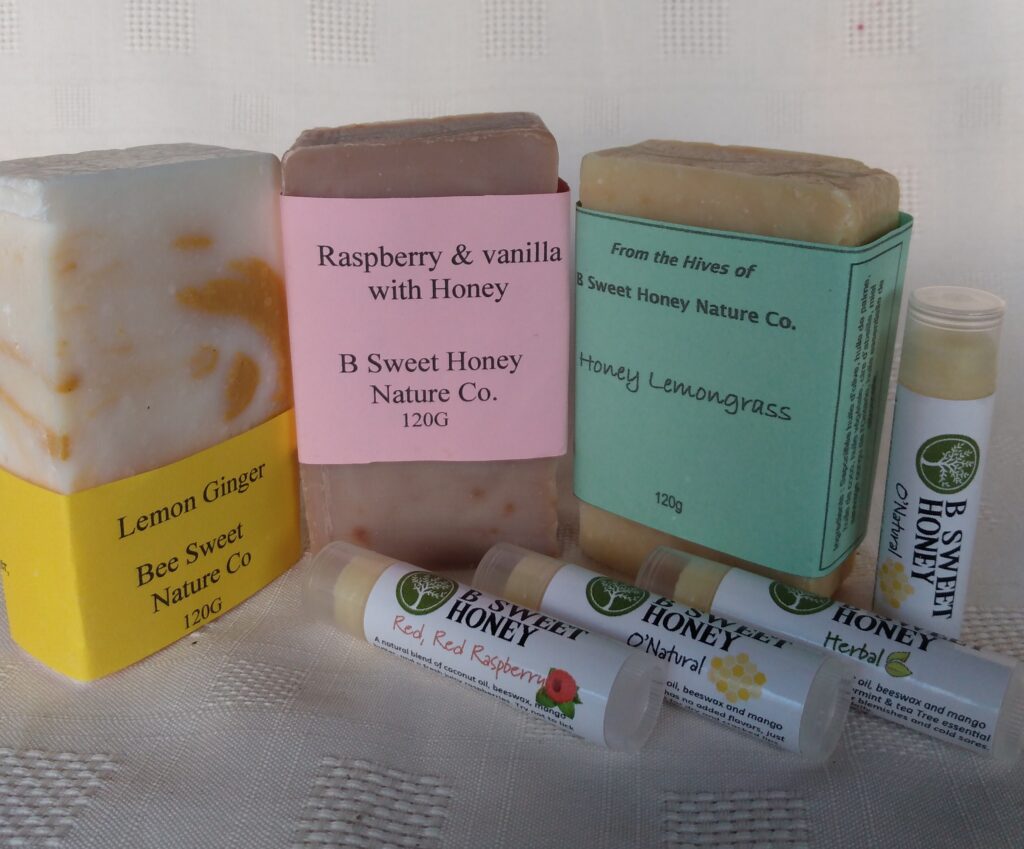
Endulge
Any 3 handmade soaps and 4 beeswax lip balms, any variety.
Be sure to visit our marketplace for pricing and charges.
The wildflowers and larval plants are looking good for our upcoming butterfly festival. We have set the date for August 8, with a plant sale from August 1-9. If you wish to preorder and pickup on a requested date, that is fine. Some plants to look forward to are sullivants milkweed, swamp milkweed, showy milkweed, hoary vervain, tall sunflower, wild lupin, big bluestem grass, common hoptree and spicebush.
During the many cold and, sometimes, snowy spring days we started compiling a wildflower database. These are wildflowers, native to Ontario, that we grow and will be growing. This is not the usual listing. We have targeted these plants because of their great capacity for nectar production or they serve an important niche. To see our database just follow the link to our wildflower knowledge base.
An approach to a new normal? We are not at the point where customers can roam through our daily work space and greenhouse. However, we have the next best thing. We brought our work space to you on these rolling racks. Of course, our full inventory is online on our bee sweet website.
Milkweeds are definitely under rated plants and, unfortunately, only associated with Monarch butterflies. This is a good starting point but not the full story of milkweeds. Even the name is interesting. The Genus name honors the Greek god, Asklepios, the god of medicine. There are 100 species throughout the world and Canada has 13 native to her soils of which Ontario boasts 11.
There have been planting programs to bring back milkweeds to the landscape. Why? The obvious answer is that this plant group is the food source for the magnificent Monarch and its caterpillars. The loss of milkweeds in Monarchs spring and summer breeding areas is believed to be a significant factor for their decline in populations. Agricultural intensification, development of rural lands and the use of mowing and herbicides to control roadside vegetation have all lead to the drastic decline of milkweeds.
But beyond the Monarch, many insects and hummingbirds drink nectar from its flowers. In fact, because milkweeds produce vast amounts of nectar over a sustained period, it is rated by pollination experts as a plant of special value to native bees. Orioles will use the plant fibers from its stems to construct nests. Other nesting birds use the silks from seed pods to line their nests. The Queen butterfly, dogbane tiger moth and milkweed tussock moth also use milkweed as their larval plant.
In Nature, every act uses biological energy. The production of flowers, leaves and nectar are all carefully planned since energy must be diverted into each process. The production of high quality nectar by milkweeds is no accident and is totally dependent on the process of pollination. The pollination path of milkweeds is quite complicated and intricate.
All milkweeds are incompatible. They can’t pollinate themselves but must depend on insects to transfer pollen between unrelated plants. Compared to other insect visited flowers, milkweeds are very unique. Their pollen is contained in small, waxy sacs (pollinia) that are located in vertical grooves (stigmatic slits) within the flower. Each pollinia contains several hundred pollen grains which are inaccessible to pollinators visiting, milkweed must offer large amounts of nectar as a reward. Not only does milkweed offer large amounts of nectar, the nectar is of very high quality.
When insects come for their nectar reward, their legs or mouth parts may slip into the stigmatic slits and come into contact with the pollinia sacs containing the pollen grains. The sacs are barbed in nature and is removed from the flower as the insect tugs its body part out of the stigmatic slit. The unknowing insect then transfers pollen to the next milkweed. Although this process is complicated it does not require ‘specialist’ insects. Insects need only be large enough to remove and carry the pollinia to the next flower.
Interestingly, not all larger insects visiting milkweeds are equal in their pollinator abilities. A huge array of insects visit milkweeds from bees, wasps, butterflies, moths, flies and beetles. It is the large bees and wasps and butterflies that are the most efficient pollinators of milkweed. And even though Monarch butterflies visit milkweed flowers often, they are not efficient at transferring pollinia. Believe it or not, it is the swallowtail butterfly family that are important pollinators of this plant. From my research, bumble bees, honeybees, eastern carpenter bees are the most significant insect pollinators.
If you would like to read further on the native milkweeds of Ontario please visit the milkweed article.
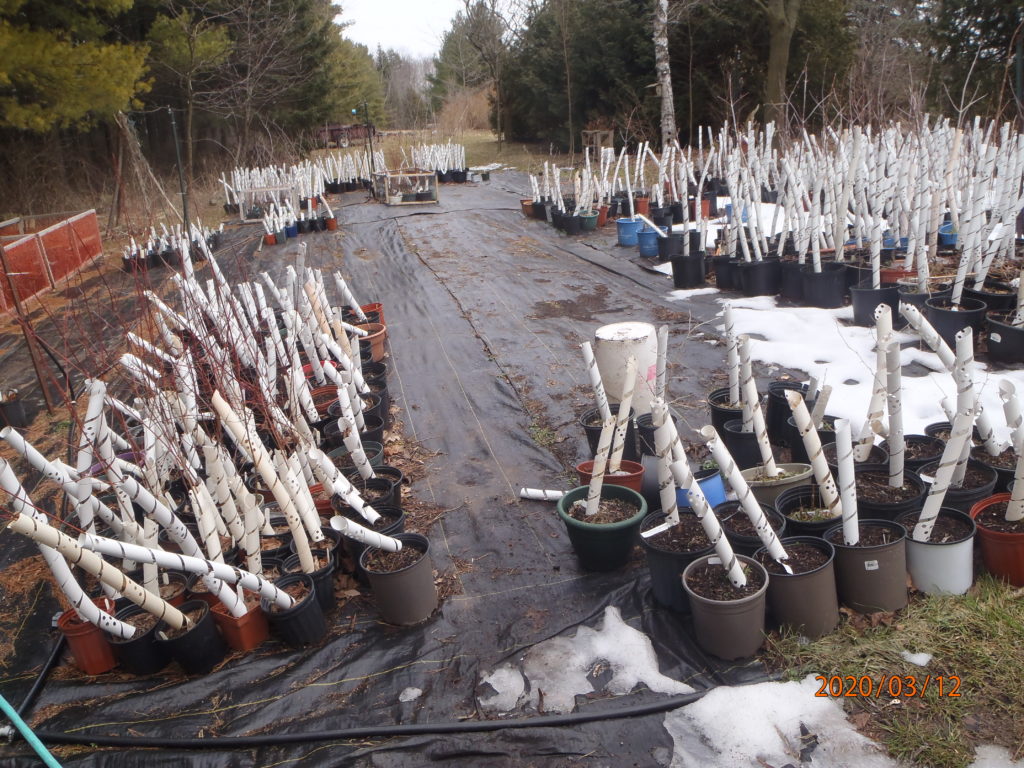
With milder temperatures, the trees are starting to show signs of breaking dormancy. Now the daunting task of unloading the greenhouse and organizing the tree yard.
Dormant trees
We will be conducting our winter damage assessments over the next weeks and then start contacting our customers on our Wish list.
We have just posted the next article about plastics on our website. Please follow this link. This delves into how to slowly become less dependent on plastic and how to eliminate it from your everyday lifestyle.
Assortment of plastic bottles
So far it has been quite painless for us though we have a long way to go in both our personal lifestyles and that of our business to be near zero plastic free. It is achievable one small plastic free footstep at a time.
Sometimes you can’t see the forest for the trees. Such was the case of the ancient Black Tupelos aged 400 – 500 years old. We purposely waited till the Fall so that we could see their brightly colored leaves on the forest floor. A great harvest day. Very excited about this years germination. To see the full story, follow the link.